



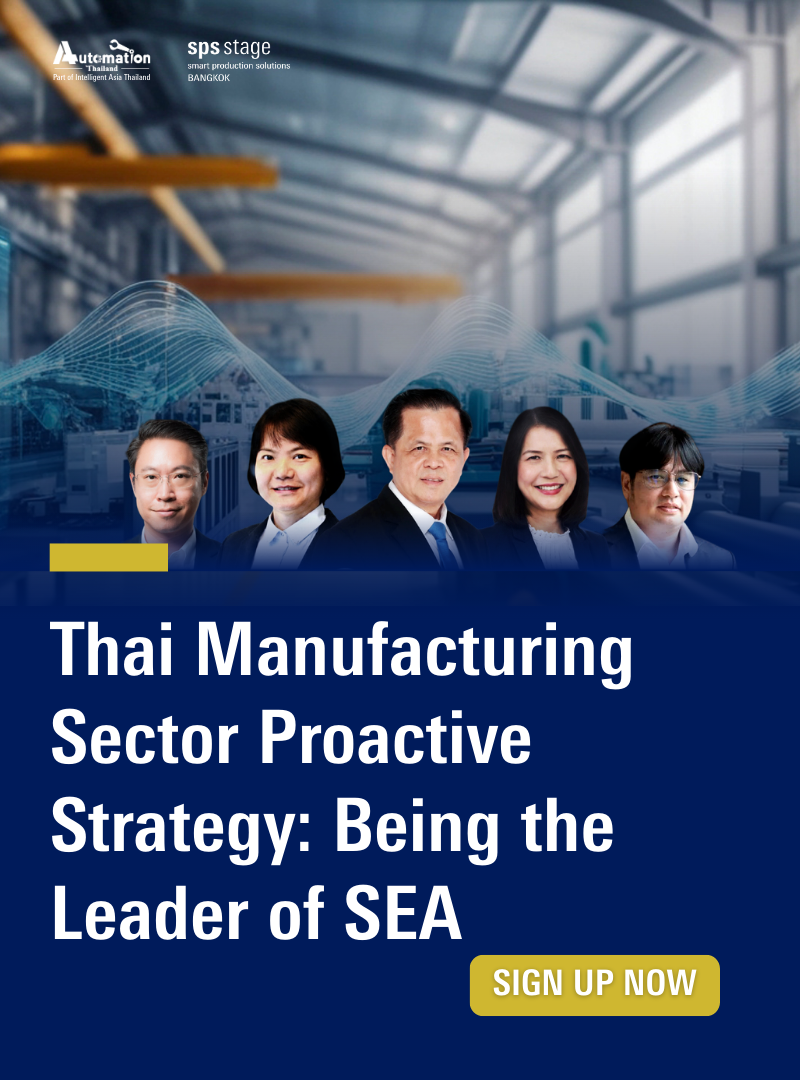
Thai Manufacturing Sector Proactive Strategy: Being the Leader of SEA
Time: 11 March 11:15 - 12:30
Speaker:
- Mr.Kriengkrai Thiennukul, Chairman, Federation of Thai Industries
- Miss Vorawan Norasucha, Director, Acting Senior Executive Investment Advisor and Executive Director of Investment Promotion Division 2, The Board of Investment of Thailand (BOI)
- Panita Pongpaibool, Ph.D., Deputy Executive Director, National Electronics and Computer Technology Center / Executive Director, Sustainable Manufacturing Center
- Arj Chankawee, Senior Expert, McKinsey & Company
Moderator: Mr.Teera Kittiteerapornchai, CEO & Managing Director, GMTX Company Limited
Thailand’s manufacturing sector is currently facing contraction, particularly from early 2025 through the third quarter, with forecasts indicating that the Manufacturing Production Index (MPI) and manufacturing GDP growth in 2026 may reach only 1.0–2.0%. This trend reflects a clear decline in competitiveness. One contributing factor is the misalignment of traditional core industries—such as automotive manufacturing—with changing market demand, compounded by the rapid disruption caused by emerging technologies like electric vehicles, where China has become a dominant player. In this critical period of transition, proactive and strategic action is no longer optional but essential to reclaim competitive advantage.
Core insights:
- Global economic challenges and the current state of international manufacturing
- Competitive opportunities and strategic positioning of Southeast Asia
- Assessing government readiness and support mechanisms for Thai manufacturers
- Perspectives from leading global experts, viewed through Thailand’s industrial and market context
- Collaborative dialogue to shape a strategic roadmap for Thailand’s manufacturing future
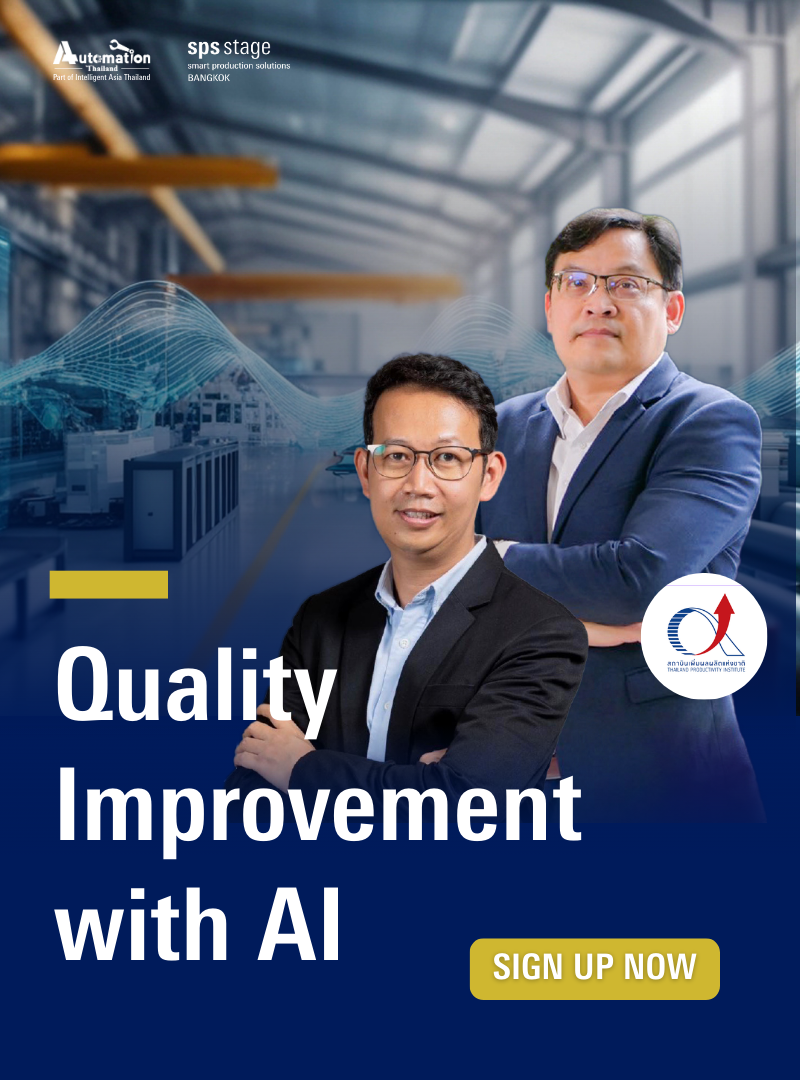
Quality Improvement with AI
Time: 11 March 13:00 - 14:20
Speaker:
- Mr. Wuttipong Boonnaiva, Director, Consulting Division, Thailand Productivity Institute (FTPI)
- Mr. Ratchapol Sittisin, CEO, MP Engineering System Co., Ltd., Thailand Productivity Institute (FTPI)
Today’s manufacturing landscape demands higher quality standards while facing rapid shifts in customer expectations. This makes AI an essential component of modern quality assurance. According to data from 360iResearch, the global market for AI Machine Vision is projected to reach 19.9 billion USD in 2024, rising to 24.11 billion USD in 2025 with a CAGR of 20.91%, and soaring to 90.95 billion USD by 2032. These figures highlight the growing competitive edge that AI brings to quality inspection.
Core insights:
- Challenges in modern quality inspection
- Guidelines and conditions for applying AI within manufacturing quality assurance
- Notable case studies
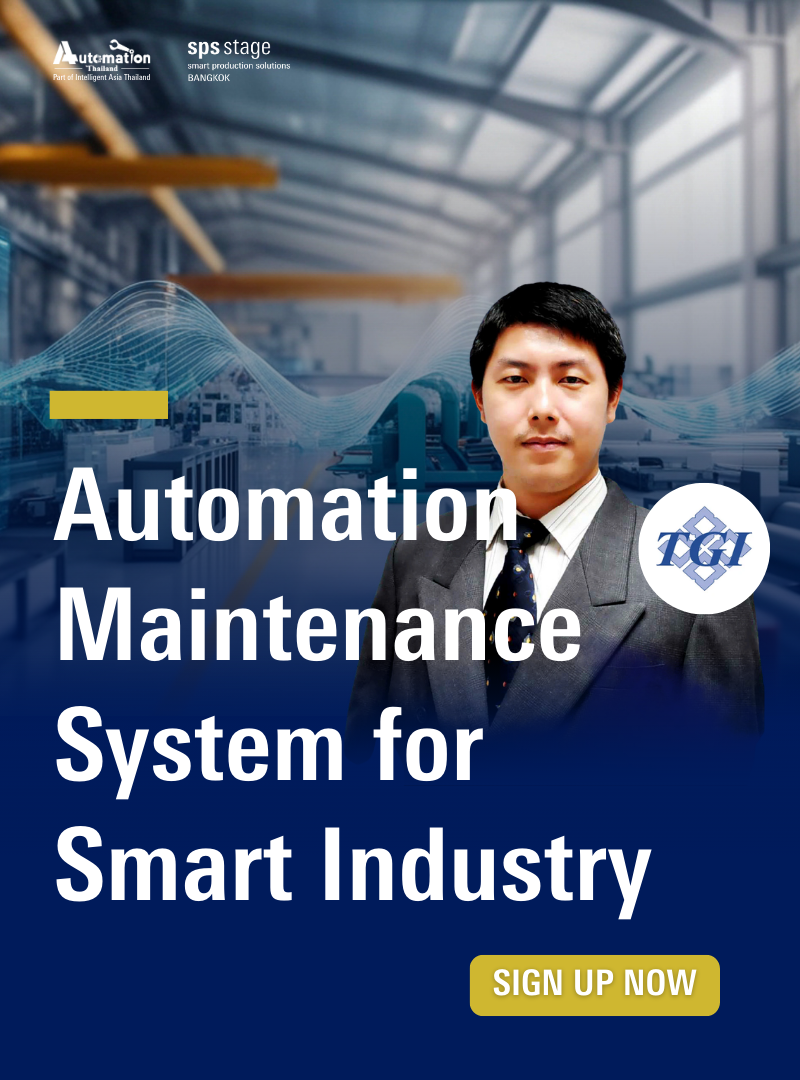
Automation Maintenance System for Smart Industry
Time: 11 March 14:20 - 15:25
Speaker: Mr. Anupong Singha, Manager, Thai–German Institute
No matter how rapidly technology advances, the role of people continues to grow in value. According to The Business Research Company, the global industrial maintenance services market reached 54.47 billion USD in 2024 and is projected to grow at a CAGR of 6.2% to 73.19 billion USD by 2029. The aviation sector serves as a major growth driver, while the Asia–Pacific region represents the fastest-growing market. These rising demands, combined with increasing technological complexity, push smart-manufacturing-driven industries—such as BESS, EV, advanced electronics, and aerospace—to strengthen their maintenance competencies and rethink their strategies to keep pace with modern production systems.
Core insights:
- Key differences between traditional maintenance and modern automated maintenance systems
- How to enhance predictive maintenance through smart manufacturing technologies in Industry 4.0
- Case studies on modern automated maintenance systems from TGI’s perspective
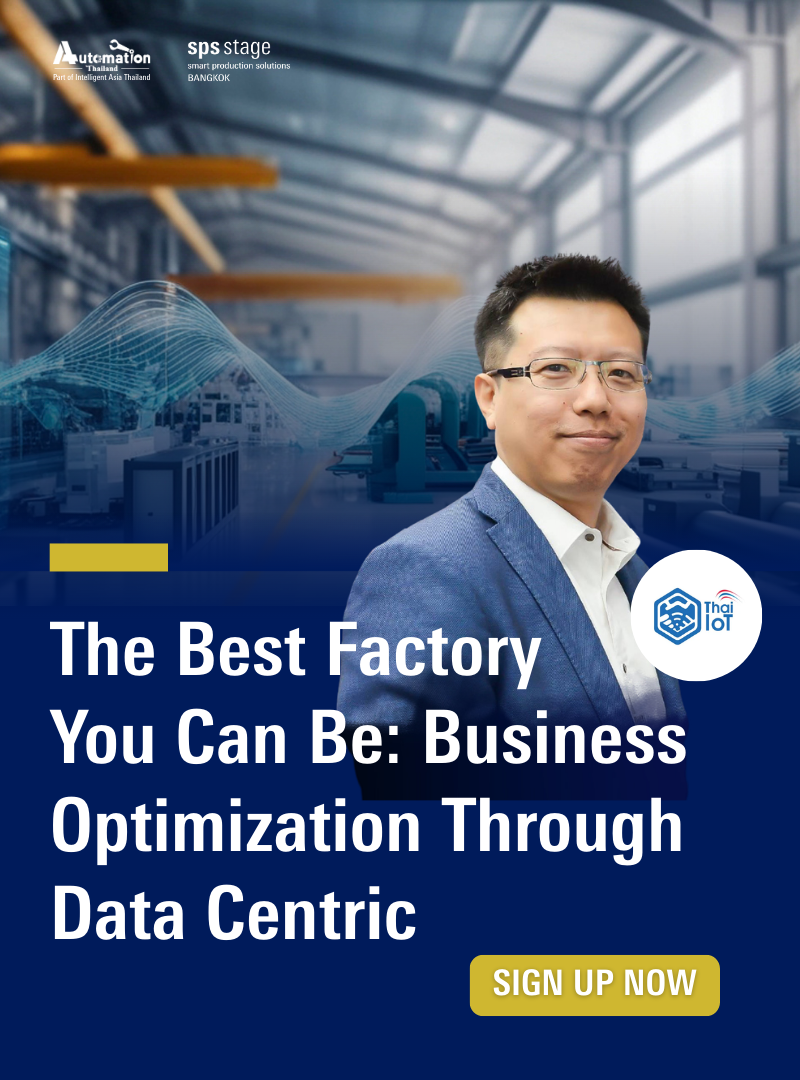
The Best Factory You Can Be: Business Optimization Through Data Centric
Time: 11 March 15:25 - 16:10
Speaker: Mr. Sakda Sarapatwittaya, Automation and Robotics Specialist, Thai IoT Association
Have you ever wondered whether your factory is truly operating at its full potential? While investing in technologies such as robotics can improve production efficiency, the real foundation lies in using available resources effectively. This transformation begins with leveraging data in a structured and meaningful way.
To optimize production planning and machinery utilization, factories must rely on accurate data to support operational and strategic decisions. This requires a well-designed data collection process that ensures accuracy, reliability, and real-time responsiveness—allowing manufacturers to further analyze and utilize data effectively.
This seminar will explore how manufacturers can enhance business performance through comprehensive, data-driven strategies and decision-making.
Core insights:
Designing effective data collection systems within factories
Applying data for efficient planning and decision-making
Case studies demonstrating successful data-driven factory transformation
AIoT & EDGE in Modern Manufacturing
Time: 12 March 10:30 - 11:50
Speaker: Mr.Suvicha Manusmontree, Executive Committee, Thai IoT Association
IoT, IIoT, and AIoT technologies have become essential for factories of all sizes, enabling complete, accurate, transparent, and real-time access to production and warehouse data. According to Grand View Research, the global AIoT market value is estimated at 171.4 billion USD in 2024 and is expected to reach 896.8 billion USD by 2026, with a CAGR of 31.7% from 2025 to 2030. This growth reflects how AI is being integrated with IoT to enhance device performance and drive complex processes through intelligent systems.
Core insights:
- Understanding IoT, IIoT, AIoT, and Edge technologies for smart manufacturing
- Practical guidance on implementing AIoT and Edge for both executives and operations teams
- Lessons learned: success and failure cases in adopting AIoT and Edge in modern factories
The Rise of Cobots: When Humans and Robots Work Together in the Era of AI-Driven Production
Time: 12 March 13:00 - 13:30
Speaker: Mr.Chatchai Pholmoon, Vice President of Collaboration and Business Development, Thai Automation & Robotics Association (TARA)
The modern manufacturing world is one where human capabilities and technology must work in synergy. Human strengths—such as flexibility, creativity, and real-time problem solving—are combined with robots’ precision, speed, and consistency. Supported by AI, these elements enable production processes to operate seamlessly and at maximum efficiency.
Core insights:
- Pathway for collaborative robots to operate together with labour
- Key talents for next-generation factory ecosystem
- Use cases
Effective Signaling Integration in a Smart Factory Eco System

Time: 12 March 13:00 - 13:30
Speaker: Martin Koenczoel, Product Manager, Auer Signal
In an era where factories are becoming increasingly connected and automated, effective signaling is no longer just a safety feature—it’s a key driver of efficiency, transparency, and predictive decision-making. In this session, Martin Koenczoel, Product Manager at Auer Signal, will demonstrate how Smart Signaling can be seamlessly integrated into a modern factory ecosystem to provide real-time operational insights, support predictive maintenance, and enhance overall workflow management. Attendees will learn how intelligent signals can reduce downtime, improve responsiveness to production events, and enable operators and management to make faster decisions. Join us to explore practical strategies and innovative solutions that turn traditional signaling into a smart, connected component of tomorrow’s factory.
Core insights:
- Explore how Smart Signaling can be seamlessly integrated into a modern factory ecosystem to provide real-time operational insights, support predictive maintenance, and enhance overall workflow management.
- Discover how intelligent signals can reduce downtime, improve responsiveness to production events, and enable operators and management to make faster decisions.
Pioneering Innovation & Application of Embodied AI
Time: 13 March 12:30 - 13:00
Speaker: Mr. Max Gao, Overseas Sales Manager, Hangzhou Yunshenchu Technology Co., Ltd.
DEEP Robotics, founded in 2017, is an international high-tech enterprise specializing in the R&D, production, sales, and service of humanoid robots, quadrupedal robots, and their core components. The company is committed to independent innovation, with cutting-edge technologies in advanced control algorithms, intelligent environment perception, and artificial intelligence algorithms that are at the forefront of international standards.
DEEP Robotics has deeply expertise in industry applications, including energy, emergency rescue, industrial operations and education. The related applications and products have been interviewed and reported by leading international media outlets such as Reuters, BBC and Bloomberg, and have been featured on the cover of the authoritative journal “Science Robotics”
'Kaizen' The Key to TOYOTA's Manufacturing Success
Time: 13 March 13:00 - 14:20
Speaker: Mr. Wasan Kanlaya, Assistant Program Chair, Bachelor of Science in Logistics and Digital Supply Chain, Faculty of Digital Technology for Industrial Business, Thai-Nichi Institute of Technology
Technology today acts as a multiplier—amplifying outcomes only when built on strong foundational practices. Establishing this foundation through productivity principles such as KAIZEN has become essential for modern factories. Toyota serves as a defining model, showcasing how KAIZEN has driven sustainable growth. For example, insights from ‘The Toyota Way in Services: The Case of Lean Product Development’ reveal that while new car model development typically used to take 20–30 months, Toyota’s approach reduces this to 15 months, or just 12 months in the case of the simpler Corolla. These achievements reflect a robust and efficient operational structure. Even in today’s era of intelligent technologies, the fundamentals of the Toyota approach remain consistent. Since 1985, an estimated 30–40% of its success has come from TPS integration, while over 60–70% has been driven by people—a ratio that still holds true today. This underscores that LEAN and KAIZEN are enduring priorities that must be continually evaluated and applied, no matter how much time passes.
Core insights:
- Explore KAIZEN through Toyota’s lessons and proven successes
- How to apply KAIZEN effectively in real operations
- Approaches for integrating KAIZEN with modern manufacturing technologies
The Pathway to Enter High Value Electronic Component Manufacturing for Factory and Labour
Time: 13 March 14:20 -15:25
Speaker: Dr. Wutthinan Jeamsaksiri, Principal Researcher, Thai Microelectronics Center (TMEC)
Thailand is entering a pivotal phase in its industrial transformation. High-value electronic components—especially PCBs and semiconductors—are now major magnets for global investment and key growth drivers. BOI reports over 500 semiconductor and advanced electronics projects from 2022 to June 2025, totaling more than 700 billion THB. The PCB sector alone saw 180 projects worth over 200 billion THB, while the first half of 2025 recorded 168 semiconductor-related proposals exceeding 108 billion THB. These figures underline the massive opportunities ahead—and pose a crucial question: how can Thai factories and workers adapt and thrive in this new era?
Core insights:
- Assessing global and regional market value and growth opportunities in the high-value electronics sector
- Understanding current workforce skill gaps and the readiness of Thai factories for next-generation high-value electronics manufacturing
- Lessons learned from international transitions into high-value industries, and how Thailand can succeed by leveraging its strengths